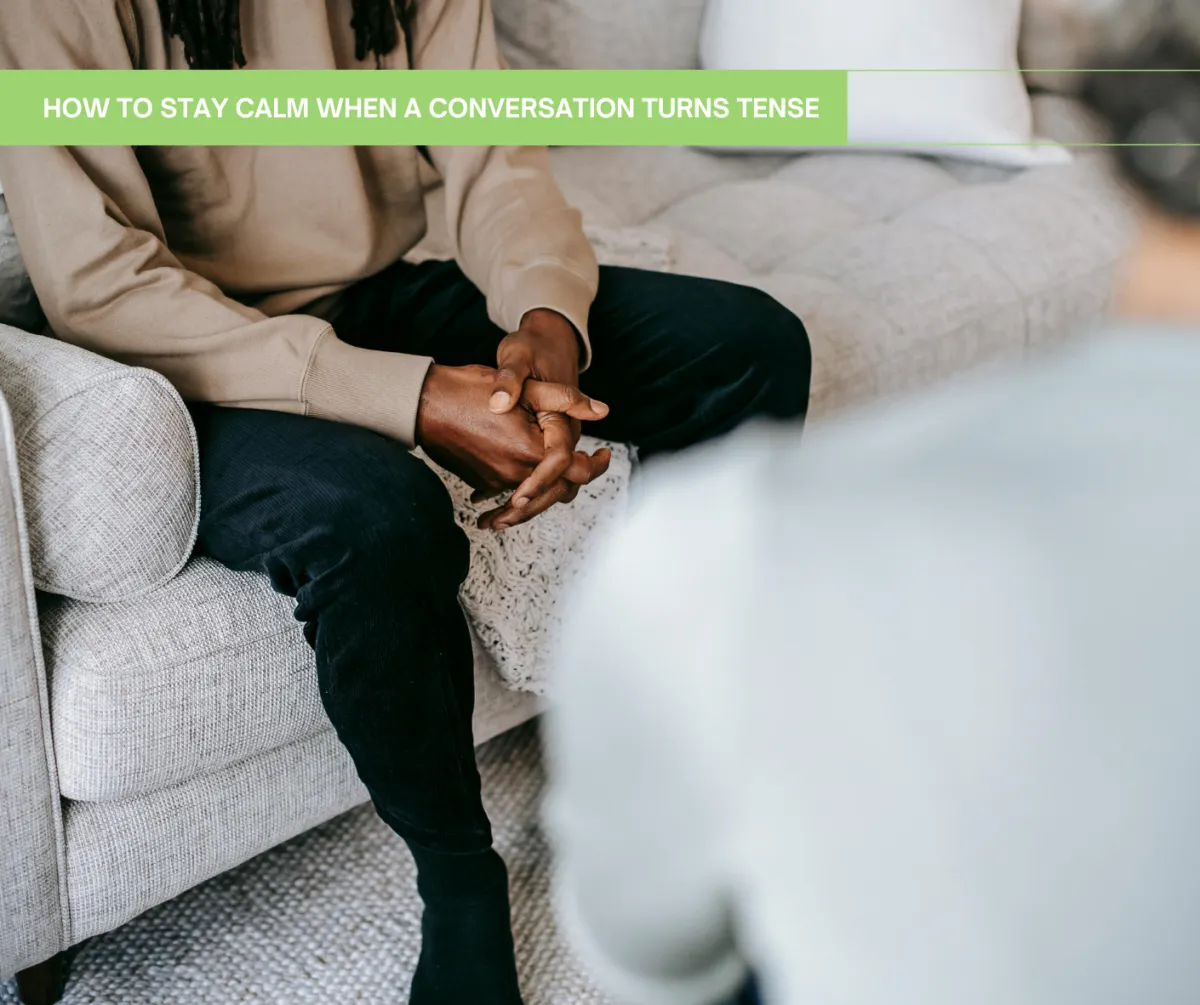
How to Stay Calm When a Conversation Turns Tense
You can enter a conversation calmly and still feel your emotions rise.
It may happen when someone interrupts you.
It may happen when you feel blamed.
It may happen when your intentions are misunderstood.
It may happen when the tone shifts and suddenly the conversation feels unsafe.
This is one of the hardest parts of conflict.
You may know what kind of person you want to be, but pressure can pull you into a version of yourself you do not like.
You raise your voice.
You shut down.
You say too much.
You say nothing at all.
Then later, you replay the conversation and wish you had handled it differently.
This is not a character flaw.
It is a regulation issue.
And regulation can be learned.
Your Body Reacts Before Your Words Do
When conflict rises, your body often responds before your mind has fully processed what is happening.
Your heart rate may increase.
Your breathing may change.
Your muscles may tighten.
Your thoughts may speed up.
You may feel the urge to defend, escape, explain, or attack.
This is why it can be difficult to stay calm in tense conversations.
Your nervous system may interpret the conversation as a threat, even if the actual issue is something you can handle.
That does not mean you are weak.
It means you are human.
But once you understand what is happening, you can begin to work with it instead of being controlled by it.
Calm Begins With Awareness
You cannot manage what you refuse to notice.
Before you can stay calm, you have to recognize your early warning signs.
Ask yourself:
What happens in my body when I feel attacked?
Do I get quiet?
Do I talk faster?
Do I become defensive?
Do I interrupt?
Do I feel pressure in my chest?
Do I mentally prepare my argument while the other person is still speaking?
These signs matter.
They tell you when you need to slow down.
Many people wait until they are already overwhelmed before trying to calm themselves. By then, the conversation has often moved too far.
Awareness gives you an earlier entry point.
Pause Before You Protect Yourself
When tension rises, most people move into protection.
They protect their image.
They protect their point.
They protect their pride.
They protect their position.
But sometimes the thing you use to protect yourself creates more conflict.
A sharp response may protect your pride, but damage trust.
Silence may protect you from confrontation, but create confusion.
Overexplaining may protect your intention, but overwhelm the other person.
Before you protect yourself, pause.
Ask:
What is the wisest response right now?
Not the fastest response.
Not the most satisfying response.
The wisest one.
That question creates space.
Use Slower Words
When a conversation becomes tense, do not try to win with speed.
Slow the conversation down.
You can say:
“Let me think for a moment before I respond.”
“I want to answer that carefully.”
“I hear what you are saying, but I need a second to process it.”
“I do not want to react. I want to respond clearly.”
These phrases do two important things.
They give you time.
They also signal that you are trying to handle the conversation responsibly.
You do not have to fill every silence.
Sometimes silence is where self-control returns.
Lower the Emotional Temperature
In conflict, tone can either inflame or calm the moment.
A calm tone does not guarantee the other person will calm down, but it gives the conversation a better chance.
Lowering the emotional temperature may mean:
Speaking more slowly.
Using fewer words.
Naming the issue without attacking.
Acknowledging what you heard.
Avoiding exaggerations like “always” and “never.”
Staying focused on one issue at a time.
If the conversation becomes too heated, lowering the temperature may also mean taking a break.
You can say:
“I want to continue this, but not while we are both this upset.”
That is not weakness.
That is wisdom.
Do Not Confuse Calm With Silence
Some people think staying calm means saying nothing.
Not always.
Silence can be wise in certain moments, but silence can also become avoidance.
Calm means you are choosing your response, not being controlled by the moment.
Sometimes calm sounds like:
“That is not how I see it.”
“I need to clarify something.”
“I am willing to discuss this, but I do not want to be spoken to that way.”
“I hear your concern, and I also need you to hear mine.”
“I want resolution, not another argument.”
Calm can still be clear.
Calm can still be firm.
Calm can still tell the truth.
Choose the Outcome Before the Response
Before you respond in a tense conversation, ask:
What outcome am I trying to create?
If the outcome is understanding, respond in a way that invites clarity.
If the outcome is a boundary, respond in a way that names the limit.
If the outcome is repair, respond in a way that acknowledges the impact.
If the outcome is resolution, respond in a way that moves the conversation forward.
Most people respond based on emotion first and outcome later.
Reverse that.
Choose the outcome first.
Then let your response serve that outcome.
Final Thought
You do not need to be emotionless to handle conflict well.
You need to be aware enough to pause, grounded enough to respond, and clear enough to move the conversation in a better direction.
Calm is a skill.
It can be practiced.
It can be strengthened.
And when you learn to stay calm under pressure, you protect more than the conversation.
You protect your peace.
If you are ready to handle disagreements, conflict, and confrontation with more calm and confidence, begin here:
MindMasterCourse - How to Deal with Disagreements, Conflict and Confrontation
