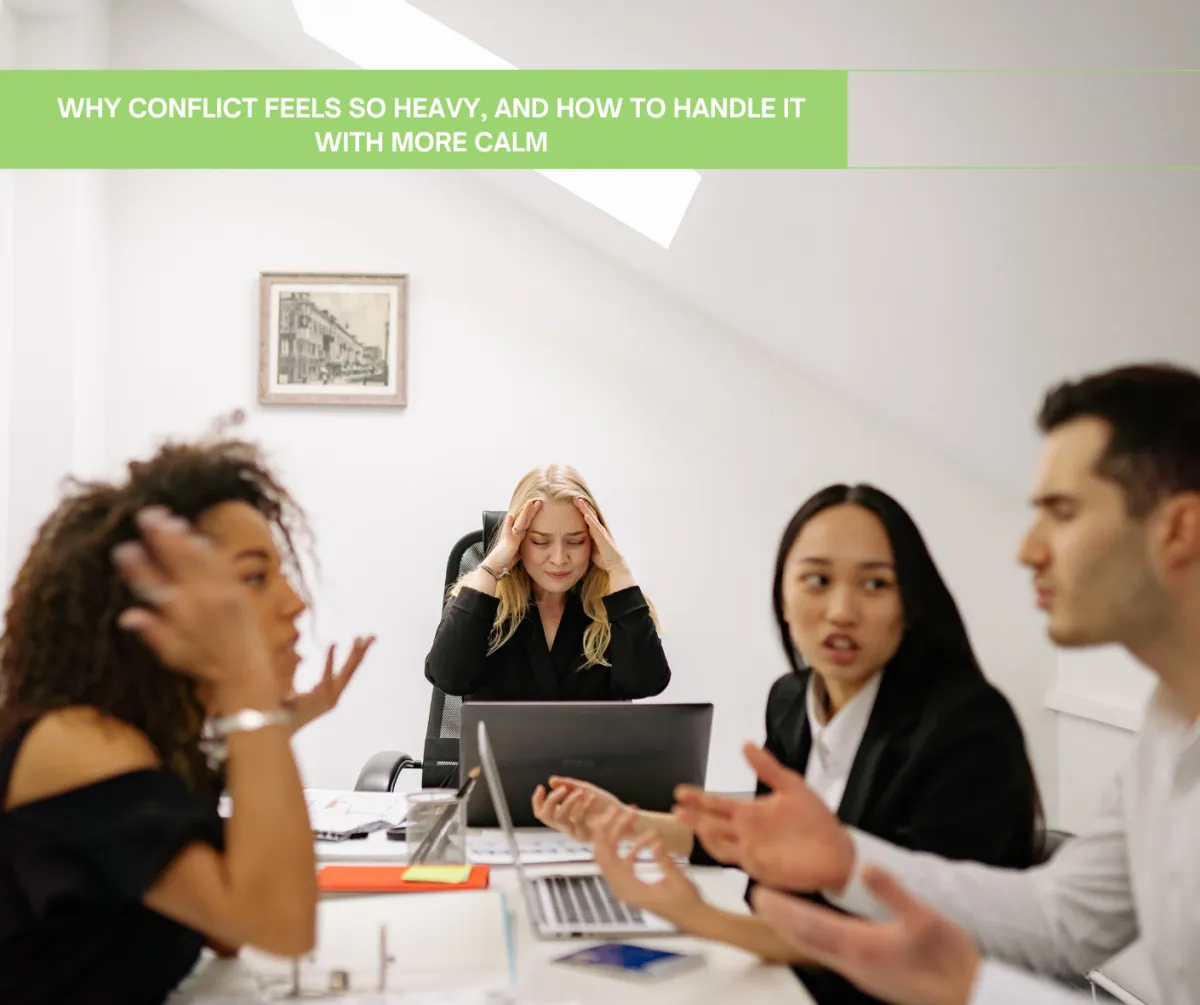
Why Conflict Feels So Heavy, and How to Handle It With More Calm
Conflict is not always the problem.
The way we carry conflict is often the problem.
A disagreement happens. A conversation turns tense. Someone says something sharp. A small issue becomes a larger argument. And before long, your mind is replaying the moment again and again.
What should I have said?
Why did they say it that way?
Did I overreact?
Will this change the relationship?
This is why conflict feels so heavy. It does not only happen in the conversation. It follows you afterward. It sits in your body. It affects your peace. It can shape the way you see yourself and the other person.
But conflict does not have to control you.
You can learn to handle disagreement with more calm, clarity, and confidence.
Conflict Feels Heavy Because It Touches More Than the Issue
Most arguments are not only about the thing being discussed.
They are often about what the issue represents.
A comment may feel like disrespect.
A disagreement may feel like rejection.
A correction may feel like criticism.
A boundary may feel like abandonment.
A delay may feel like being ignored.
This is why two people can argue about something small and react as if something much larger is happening.
The issue may be practical, but the response is emotional.
That does not mean your emotions are wrong. It means there may be more happening under the surface.
The first step in handling conflict better is learning to slow down enough to notice what is really being triggered.
Calm Is Not Weakness
Some people believe calm means passive.
It does not.
Calm does not mean you ignore the issue. It does not mean you let people speak to you however they want. It does not mean you avoid truth just to keep the peace.
Calm means you are not letting pressure control your behavior.
That is strength.
Anyone can react when emotions rise.
It takes maturity to pause, think, and respond with intention.
Calm gives you access to better choices.
When you are calm, you can listen more clearly. You can speak more carefully. You can notice what matters. You can decide whether the conversation needs to continue, pause, or be handled differently.
Calm does not remove conflict.
Calm helps you navigate it.
The Cost of Reacting Too Quickly
Many conflicts become worse because of speed.
Someone says something.
You respond immediately.
They defend themselves.
You defend yourself.
The tone rises.
The original issue gets buried under new wounds.
This is how a disagreement becomes a confrontation.
Not because the topic was impossible to solve, but because the pace became too fast for wisdom.
A quick reaction may feel honest in the moment, but it can create words you later regret.
This is why one of the most powerful conflict skills is the ability to pause.
A pause gives you space.
Space gives you choice.
Choice gives you control.
Ask Better Questions Before You Respond
When conflict begins, many people ask the wrong internal question.
They ask, “How do I win this?”
A better question is, “What is really happening here?”
That one shift changes the conversation.
Instead of preparing your defense, you begin looking for understanding.
Ask yourself:
What is the actual issue?
What emotion is being triggered in me?
What might the other person be reacting to?
Is this the right time to continue the conversation?
What outcome do I want after this is over?
These questions do not make you weak. They make you wise.
Conflict handled with wisdom can lead to clarity. Conflict handled from reaction usually creates more conflict.
You Can Be Direct Without Being Destructive
Some people avoid conflict because they do not know how to be direct without being harsh.
Others become harsh because they think directness requires force.
Neither approach creates healthy resolution.
You can be honest and respectful.
You can be firm and calm.
You can name a problem without attacking a person.
You can set a boundary without creating unnecessary damage.
A helpful phrase is:
“I want to address this clearly, but I do not want us to turn against each other while we do it.”
That kind of statement changes the tone. It reminds both people that the goal is not to destroy the relationship. The goal is to deal with the issue.
Resolution Requires More Than Being Right
Being right may feel satisfying, but it does not always create resolution.
Sometimes people become so focused on proving their point that they forget the larger purpose of the conversation.
Do you want to be understood?
Do you want to repair trust?
Do you want to solve the problem?
Do you want to set a boundary?
Do you want to move forward with clarity?
Each of those goals requires a different approach.
If your only goal is to win, you may lose the relationship, the opportunity, or the peace you were trying to protect.
Real resolution requires honesty, humility, and structure.
A Simple Practice for the Next Conflict
The next time you feel yourself getting pulled into conflict, try this:
Pause before responding.
Name the issue clearly.
Lower the emotional temperature.
Speak to the problem, not the person.
Ask what resolution would look like.
You might say:
“I want to understand what happened here.”
“Let’s slow this down so we do not make it worse.”
“The issue I want to address is this.”
“I hear your concern. Here is what I need to clarify.”
“What would help us move forward from here?”
These are simple phrases, but they create structure.
And structure creates calm.
Final Thought
You do not need to fear every disagreement.
You need better tools for handling it.
Conflict becomes heavier when there is no structure, no pause, and no clear path toward resolution.
But when you learn to stay calm, listen carefully, speak directly, and move toward resolution with integrity, conflict becomes less overwhelming.
You may not be able to control every conversation.
But you can learn to control how you show up in it.
If you are ready to handle disagreements, conflict, and confrontation with more calm, confidence, and clarity, begin here:
MindMasterCourse - How to Deal with Disagreements, Conflict and Confrontation
