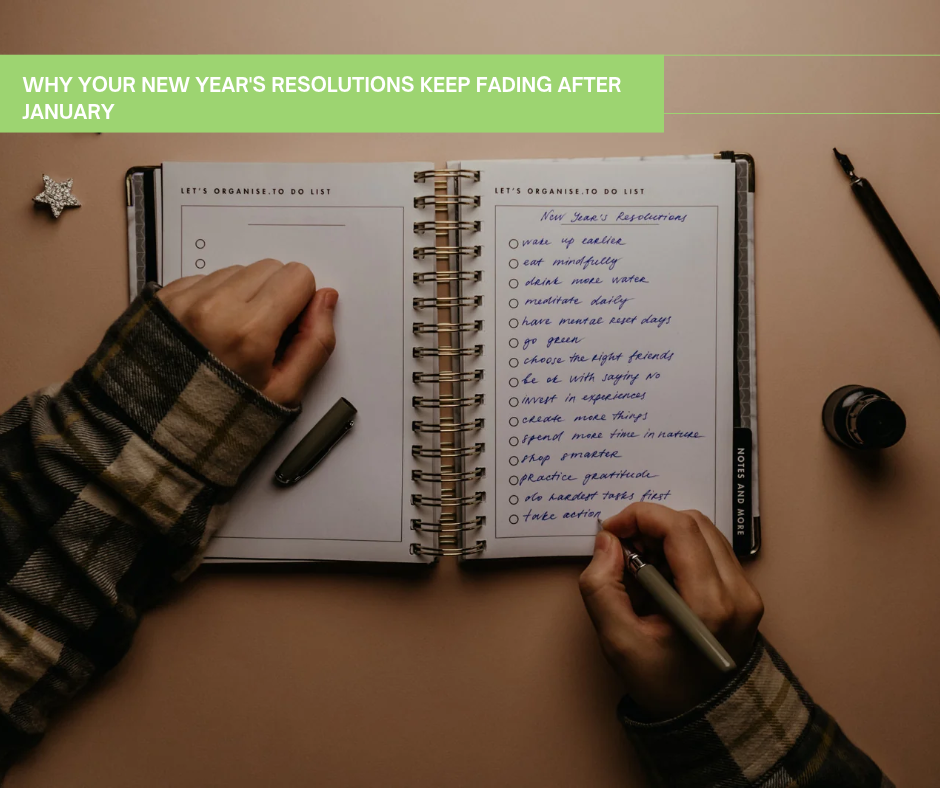
Why Your New Year's Resolutions Keep Fading After January
Every January, people make promises to themselves.
This will be the year they get healthier.
This will be the year they save more money.
This will be the year they become more disciplined, more confident, or more focused.
And for the first few weeks, everything feels possible.
There is excitement. There is hope. There is a renewed sense of determination.
But then ordinary life returns.
Work becomes demanding. Responsibilities compete for attention. Energy drops. Schedules change.
Before long, the resolution that felt so important begins to fade.
By February, many people are already wondering what happened to the promises they made just a few weeks earlier.
The answer may not be what you think.
Most resolutions do not fail simply because people lack motivation. They fail because motivation was the only thing holding the plan together.
The Resolution Cycle Most People Repeat
Think about the last resolution you made.
Perhaps you started with a strong commitment. You planned to exercise every morning, save a certain amount each month, or develop a new skill.
For a while, you followed through.
Then something interrupted the routine.
Maybe you missed a workout. Maybe an unexpected expense affected your savings. Maybe work became too busy to keep studying.
What happened next?
For many people, the pattern looks something like this:
Enthusiasm: You begin with high expectations and strong motivation.
Overcommitment: You attempt too many changes at the same time.
Friction: Real-life responsibilities make the new routine difficult.
Discouragement: A missed day begins to feel like failure.
Abandonment: You decide to start over another time.
The cycle repeats because the underlying approach never changes.
You begin with another promise, but you are still relying on the same system that failed to support you before.
Motivation Is a Starting Point, Not a Strategy
There is nothing wrong with motivation.
It can help you begin.
The problem comes when you expect motivation to carry you through an entire year.
Motivation changes.
Some mornings you feel focused and ready.
Other mornings you feel tired, distracted, or overwhelmed.
If your resolution depends on feeling enthusiastic every day, it will eventually become difficult to maintain.
This is where structure makes a difference.
Instead of saying, "I will exercise more this year," decide when and how exercise will happen.
Instead of saying, "I will manage my money better," create a regular time to review spending and savings.
Instead of saying, "I will become more productive," identify one important task to complete before distractions take over.
These are not dramatic changes.
But they turn intentions into actions you can repeat.
Why Unrealistic Expectations Create Discouragement
Another common mistake is expecting too much change too quickly.
People begin the year wanting to improve everything.
Their health. Their finances. Their relationships. Their career. Their mindset. Their daily routines.
Each goal may be worthwhile.
But attempting to rebuild your entire life in January can create more pressure than your schedule can support.
And when the plan becomes overwhelming, people often conclude that they are not disciplined enough.
Sometimes discipline is not the problem.
Sometimes the plan is simply too demanding.
A realistic commitment that you can repeat is more useful than an impressive commitment you cannot maintain.
You do not need to change everything at once.
You need to choose what matters most and build from there.
Look at What Went Wrong Before Starting Again
Before making another resolution, review the previous one.
Do not judge yourself. Study what happened.
Ask yourself:
What was I hoping to achieve?
What actions did I actually take?
When did following through become difficult?
What interrupted the routine?
What support or structure was missing?
Perhaps the goal was too broad.
Perhaps the schedule was unrealistic.
Perhaps you depended on a perfect morning routine.
Perhaps you had no plan for difficult days.
Once you identify the weak point, you can make a practical adjustment.
That is far more useful than promising yourself to try harder.
Build a Resolution That Can Survive Real Life
A lasting resolution needs room for real life.
It needs a clear action, a reliable time, and a smaller alternative for busy days.
For example, instead of requiring yourself to exercise for an hour every morning, you might plan a 25-minute walk four times each week, with a five-minute alternative when necessary.
The shorter walk may not accomplish everything the longer session would.
But it keeps the routine active.
It gives you an opportunity to return.
And it reduces the likelihood that one difficult day becomes a reason to abandon the entire goal.
Consistency is not about creating a perfect record.
It is about creating a practice you can return to.
Final Thought: Make This Year Different by Changing the System
A new year can provide fresh motivation, but it cannot automatically create lasting change.
That requires something more dependable.
Clear priorities.
Realistic actions.
Small habits.
A plan for interruptions.
And a willingness to learn from the days that do not go as expected.
You do not need another year of making promises you struggle to keep.
You need a better system for following through.
Your New Year: How to Keep Your Resolutions Permanently is designed to help you understand why past resolutions lost momentum and build practical habits and structures that support lasting progress.
If you are ready to approach your goals differently this year, explore the course and register here:
Learn More About Your New Year: How to Keep Your Resolutions Permanently
